1. Where the Story Began
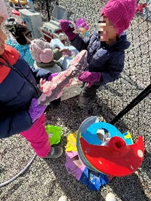
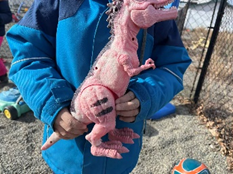
At the beginning of my practicum, I noticed that children often chose dinosaur and crocodile toys during outdoor play. One child told me:
“I like dinosaurs because dinosaurs are strong.”
When I continued to ask, “What makes dinosaurs strong?”, the child said that dinosaurs are much bigger than people, so people are weak and dinosaurs are strong. The child also explained that dinosaurs have sharp teeth and long tails, and these things make them stronger.
Later, during indoor time, the children began racing toy cars. They repeatedly said:
“Fast! Fast!”
They kept comparing different toy cars to see which one was faster. When I asked whether they liked the faster one better, the child answered:
“Yes, the faster one.”
These early moments made me realize that the children were not using the word “strong” casually. Rather, they were giving meaning to “strong” through their own experiences. Through body features, speed, and comparison, they were beginning to form their own early theories about strength. The BC ELF (2019) views children as “strong, capable in their uniqueness, and full of potential. (p.15)” For me, this was not just a slogan. It was something that was truly happening in these conversations: the children were already constructing their own ideas, rather than waiting for me to tell them the answer.
2. Early Strong: Big, Fast, and Sharp
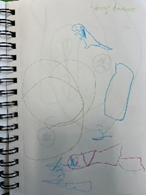
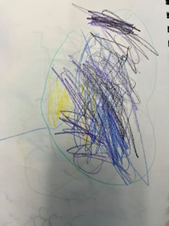
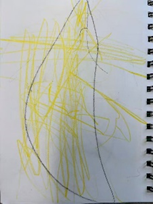
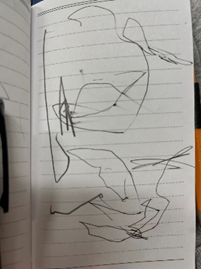
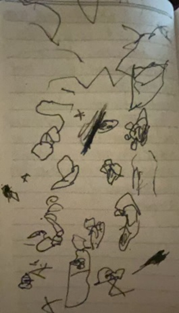
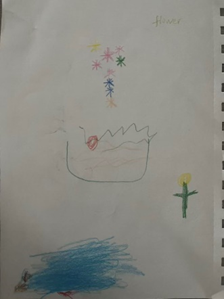
During drawing ritual, the children began to actively draw their own understandings of strong.
Some children drew long tails.
Some children drew curved, powerful bodies.
Some children drew sharp teeth and claws.
These drawings helped me see that the children’s early understandings of “strong” were mostly connected to physical characteristics.
For them, strong could mean:
- a bigger body
- a longer tail
- sharper teeth
- faster speed
At the same time, I noticed that each child’s expression was slightly different. How could these different ideas become a shared learning experience? This made me pay attention to the importance of making community and co-constructing meaning together.
3. Shared Discussion and Building Connections (Making Community)
Understanding Each Other Through Sharing
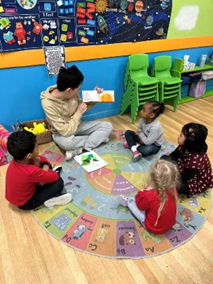
So that the children would not only express their own ideas individually, I began to invite them to talk with one another through questions and circle time while reading storybooks.
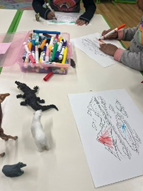
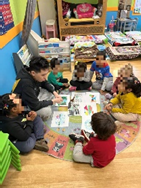
During the following drawing rituals, more and more children began to join the discussion about strong. In order to create more space for them to express themselves freely, I designed a multi-day exploration. On the first day, the children painted animal toys. On the second day, they painted habitat pictures. On the third day, during circle time, I brought these animals and habitats together and invited the children to co-construct a story.
The story began with the animals in the animal kingdom visiting a big tree. As night came closer, the animals wanted to return home, but they got lost. I asked the children:
“Which animal is strong enough to be the leader?”
The children gave different answers:
- Some children said a seal would be more suitable because it looked friendly.
- Some children chose a lion or a bear because they were stronger and could protect the other animals.
This activity was the first time I clearly felt that the children’s understanding of “strong” had begun to go beyond physical strength alone. Some children saw protecting others as strong, while some children included friendliness in what makes a leader strong. The BC ELF reminds me that “Relationships are the context for well-being and learning. (p.25)” When I looked back on this activity, I realized that what truly moved the learning forward was not only the animal materials, but also the children’s listening, comparing, debating, and responding to one another.
4. Reflection and Adjustment
In this free talk story activity, I originally hoped to guide the children to think about what kinds of qualities could make an animal strong enough to become a leader.
However, after the activity, I began to reflect on how I was sometimes too direct in linking leadership with strong. Although this kind of question helped the children enter the discussion, it may also have unintentionally narrowed their imagination. I began to realize that the issue was not whether I had designed the activity, but whether I was leading the children too quickly into a logic I had already decided beforehand.
The BC ELF says, “Educators are researchers and collaborators. (p. 17)” This sentence helped me reconsider my role in that moment. As an educator, I am not only a leader, but also a researcher. I need to study the theories the children are beginning to form, to study how my own questions influence their thinking, and to study whether my habitual ways of understanding place the “right answer” too far in the foreground. This reflection was very important to me because it moved me from being “the person who designs activities” toward being “the person who thinks with children.”
5. Footprint Matching
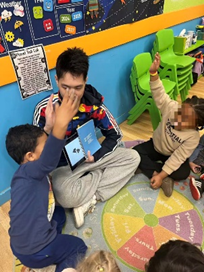
In the following circle time activity — the footprint matching game — I tried to use more open-ended questions rather than directly tying strong to one particular answer. The children matched animals with footprints and compared the sizes of different footprints, using size to identify different animals.
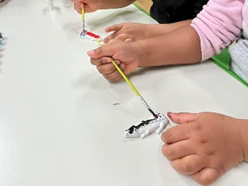
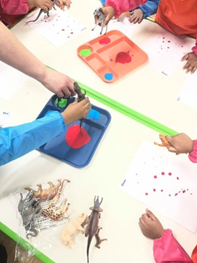
Then, in the art activity, I prepared different animal toys and paint so that the children could dip the animals’ feet in paint and stamp footprints onto paper.
I noticed that when one child chose the dinosaur toy, the child pressed much harder. When I asked why, the child said:
“I want the dinosaur footprint to look stronger because the dinosaur is bigger and heavier.”
This moment made me realize that when I reduced direct guidance, the children were still naturally connecting the activity with their own inquiry. What impressed me most here was not that the child had “answered correctly” according to my topic, but that without being pushed by me, the child still brought their own theory back into the experience.
The BC ELF states, “intentional, open listening is the basis of a reciprocal relationship. (p. 18)” For me, this sentence became very concrete here. Slowing down does not just mean speaking more slowly, and it does not simply mean saying less. It means allowing children’s words to genuinely influence what I do next.
6. Dinosaurs, Imagination, and a New Strong
Later, I designed a dinosaur-making activity.
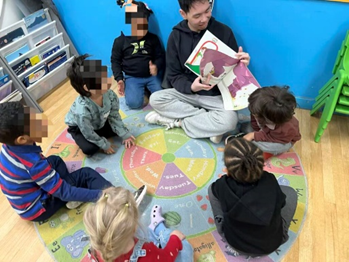
Before beginning the activity, I brought the picture book If You Happen To Have A Dinosaur into circle time, hoping to open the children’s imaginations through the story.
During our discussion, the children mentioned:
- If they had a dinosaur, they could swim with it.
- Dinosaurs are strong and could protect them.
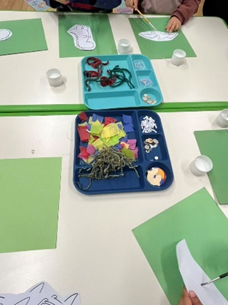
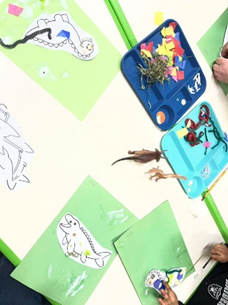
Then, during the art activity, I only provided a dinosaur outline and a variety of materials. I tried to use more questions to invite the children to explore and create the kind of dinosaur they wanted to make.
The children naturally connected our previous discussions with their creations:
- Some children chose thicker lines over thinner ones to make a longer, more “strong” tail.
- Some children used zigzag paper strips to make teeth and claws.
- Some children tried to choose bigger eyes for their dinosaurs.
I felt that when the materials and the questions remained open, the children were able to bring old experiences into new creations and continue extending their own theories.
7. Another Possibility of Strong: Cleverness as Strength
Later, during circle time, I brought in The Gruffalo. I felt that this book connected very well to the strong topic we had been exploring, because it not only described many of the Gruffalo’s body parts, but also included many different animals.
The children were very interested in the body parts of this new and unusual creature. However, during our discussion of the story, the children gave me a new direction: although the Gruffalo was big and strong, they liked the mouse more because the mouse used its intelligence to solve problems.
As a result, the children began to connect more ideas with strong:
- clever
- smart brain
- thinking
This moment stayed with me because it was when the inquiry truly shifted. Strong no longer belonged only to teeth, tails, size, and speed; it began to connect with intelligence and cleverness. The BC ELF says children “create and test theories, explore the world, and express ideas. (p. 25)” and that “rather learning is rhizomatic, moving in unexpected and surprising directions as children are in relationships with people, place, ideas, and materials. (p. 25)” I think this page best shows that children’s understanding is not linear, but instead is reorganized, compared, and extended through earlier ideas.
8. From Strong Animals to Strong Environments
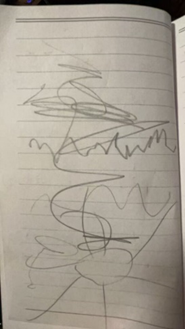
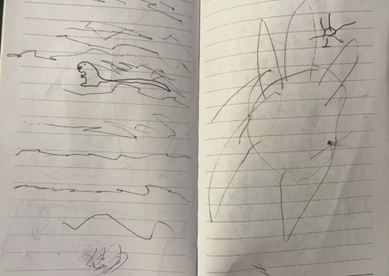
In a later drawing ritual, the children talked again about strong animals. One child drew a dinosaur, while another child drew mountains beside it.
When I asked why the mountains were there, the child said:
“A strong dinosaur needs a strong environment.”
Then the children drew long, curved mountains. One child drew a sun, and then another child drew a bigger sun and said:
“If the mountain is bigger, the sun should be bigger too.”
This moment felt very special to me because our discussion was slowly shifting from “what kind of animal is strong” to “what kind of environment this animal would live in.” The children were beginning to think that strong does not belong only to an animal’s body, but that an environment can also be strong. I believe this was an important shift.
9. Slowing Down and Hearing the Details of Trees and Flowers
The children’s ideas continued to inspire me. In the following days, we began discussing more details in this environment. The children mentioned the trees on the mountain, and together we discussed what characteristics these trees might have.
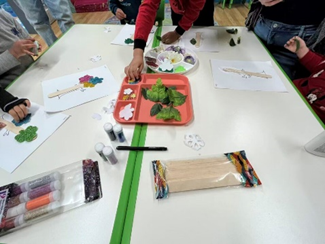
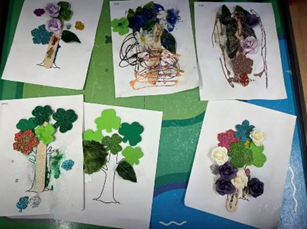
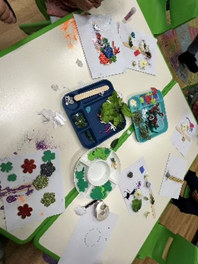
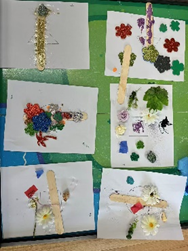
At first, I prepared a natural materials activity in which the children could create a tree on paper using flowers and small wooden pieces. However, after reflecting, I realized that this might not yet fully respond to the children’s real ideas. The BC ELF mentions, “Pedagogical narration is the process of noticing and collecting moments from daily practice and sharing these with colleagues, children, and families. (p. 51)” This reminded me that pedagogical narration is not only about recording what has already happened, but also about helping me stop, notice what the children are expressing, and reconsider how I should respond next. So I began to slow down. I did not rush to move the activity forward; instead, I continued discussing the details of the trees with the children.
During the following drawing ritual, the children mentioned:
- the trees should stand out more
- the strong animals should be surrounded by “beautiful trees”
- the trees should have many flowers
- the trees should have leaves of different sizes
Based on their suggestions, I adjusted the materials:
- I added different colours of glitter
- I provided larger leaves
- I added more varieties of flowers
I felt that inquiry is a co-constructed process. The changes to the materials were not made to make the artwork look nicer, but to respond more faithfully to the children’s expressions.
10. Entering the Materials, and Entering Imagination, Through The Very Hungry Caterpillar
On the day we formally began the tree and natural materials activity, I chose to use The Very Hungry Caterpillar as an entry point.
During the read-aloud, I tried to connect the natural elements in the story to the materials I had prepared. When natural elements appeared in the book, I invited the children to touch the leaves and flowers and feel their shapes, colours, and textures. The BC ELF states that “the importance of play for children to experience the world through seeing, feeling, touching, listening, and by engaging with people, materials, places, species, and ideas. (p.24)”
I hoped that this approach would both provide the children with an entry point into the activity and preserve its openness. The children were not there to “complete a standard tree,” but rather to explore what these materials could become through their own feelings and imaginations.
After the activity, I realized that the learning experience did not necessarily end when the artwork was finished. So I decided to leave the children’s trees displayed on the table rather than putting them away immediately. As the BC ELF states, “Environments are integral to well-being and learning. (p.22)” The environment is not simply a background. The arrangement of the environment can support children’s ongoing learning. Through these small changes in the environment, I hoped that when the children walked by again, they would continue to see one another’s work, compare different ideas, and build new connections and discussions.
11. Continuing the Exploration: Old Materials, New Understandings
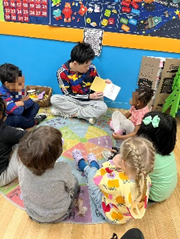
Later, I used Not a Box as a foundation. This book opened up imagination very effectively. During the reading, I continued asking the children:
“What can a box become?”
The children imagined many possibilities, such as a spaceship, a fire truck, and pirates.
In the art activity that followed, I drew different shapes on paper, including:
- a box shape
- triangles
- circles
At the same time, I brought back the old materials we had used earlier to explore strong.
I believe this was a very important form of revisiting. The children could reconnect these old materials with their earlier ideas about strong, while also extending new understandings in their new creations. In this process, I saw the children use simple shapes and familiar materials to create new meanings. They were not returning to the starting point; they were moving forward through revisiting. As the BC ELF says about pedagogical narration, “The process is living, ongoing, and continually producing something new. (p. 90)” Revisiting is not repetition. It is bringing old experiences into the present so that new understandings can grow.
12. Reflection and Passing It On
Throughout this process, I continued to observe that:
- children are capable thinkers, and they use many languages, such as materials and drawing, to express their ideas
- materials are no longer simply tools for completing tasks, but become participants in learning with children, inviting them to explore, imagine, and generate new ideas
- learning happens through relationships and dialogue
- ideas develop through ongoing exchange
- learning is alive; it is not a predetermined process, but something continually generated and transformed between children, materials, and environments
- educators are researchers, listeners, and co-learners
- the environment is no longer only the background in which activities happen, but is actively shaping children’s thinking. The placement of materials, the decision to leave work visible, and the openness of the space all influence whether children are able to continue observing, comparing, and reconnecting their ideas.
What I want to pass on to the next educator is not a finished topic, but an inquiry that is still alive. The children have already begun to extend “strong” from physical characteristics to intelligence, environment, and relationships. This story can continue to be opened through natural materials, outdoor observation, construction, stories, and revisiting. Perhaps the most important thing is not asking what activity should happen next, but continuing to ask: What are the children trying to understand now? What has not yet been fully said?